
Deliberate Practice: A focused and structured approach to skill improvement, characterized by systematic efforts to target specific weaknesses, receive feedback, and adapt strategies accordingly. Unlike mindless repetition, deliberate practice involves mindful and intentional efforts to stretch one’s abilities beyond their current level, often with the guidance of a coach or mentor.
Find the Membership that Works for You
-
Month to Month No long term contract
$475.00 / month -
1-Year Membership
$225.00 / month -
180-Day Membership
$300.00 / month -
90-Day Membership
$350.00 / month
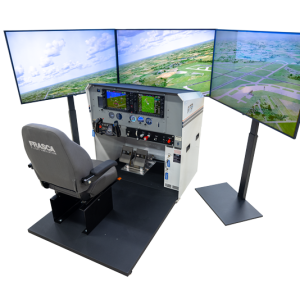
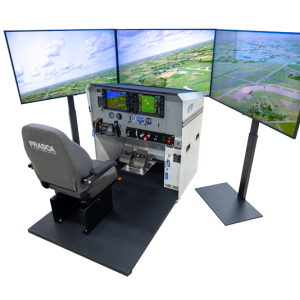
Why IFR Sim Solutions?
Unlimited Use
There is no limit to the number of hours you can fly so you can get all the practice you desire.
Learn More24/7 Access
Fly at your convenience without being limited to the flight school's hours of operation.
Instructor Not Required
Fly the simulator independently without incurring additional instructor fees.
Why IFR Sim Solutions?
Unlimited Use
There is no limit to the number of hours you can fly so you can get all the practice you desire.
24/7 Access
Fly at your convenience without being limited to the flight school's hours of operation.
Instructor Not Required
Fly the simulator independently without incurring additional instructor fees.
More Than Just a Flight Simulator
Not only hone your flying skills but also engage in real-time communication with ATC.
I'm Mark
Owner and Founder of IFR Sim Solutions
I’m Mark Chmieleski, a former U.S. Army helicopter pilot with a focus on training. During my military service, I specialized as an instructor in both AH-64 Apache and MH-47 Chinooks, also holding the role of Instrument Flight Examiner in both platforms. Following my retirement from the Army, I transitioned to flying EMS helicopters and served as a Part 135 Check Airman. Presently, I’m a corporate pilot flying the Honda Jet.
With more than 7,000 flight hours, including 3,000 hours as an instructor, I deeply understand the importance of structured training and providing clients the opportunity to refine their techniques for success.
Why I Started IFR Sim Solutions
As I pursued my IFR rating, I identified specific areas where I needed additional practice, including intersection holding, non-precision approaches, and partial panel flying. However, the expense of aircraft rental and instructor fees began to accumulate rapidly. Fortunately, my FBO introduced a limited-time offer for unlimited use of their AST-300 simulator for 90 days. Recognizing this as a valuable opportunity, I promptly enrolled and began integrating simulator sessions into my training regimen, averaging at least five sessions per week. The immediate improvement in my flight proficiency was undeniable.
As my aviation journey progressed, whether in military service or as a corporate pilot, I increasingly appreciated the benefits of simulator training. Yet, the challenge persisted: access to simulators for independent practice and experimentation with various weather conditions and aircraft configurations was limited.
Motivated by this need, I founded IFR Sim Solutions. Our platform provides clients with unlimited practice opportunities, enabling them to train at their convenience without the need for an instructor. Say goodbye to concerns about cost or exceeding flight hours. For the price of less than an hour of dual instruction, clients can engage in unlimited practice sessions, empowering them to enhance their skills and confidence in instrument flying.

Frequently Asked Questions
What can I log?
- With an instructor sign-off, you can log up to 2.5 hours of flight time toward the Private Pilot certificate. There is no limit to the total amount of training that can be logged in an AATD
- Under the FAA LOA pilots can credit a maximum of 20 hours of instrument time towards their IFR rating and 50 hours towards their Commercial certificate
- If IFR-rated pilots can use an AATD to maintain their instrument currency by completing the following tasks, Instrument approaches, holding procedures, and intercepting and tracking courses.
Is it only for IFR pilots?
No. Although mostly used for IFR training simulators are underutilized for the Private Pilot certificate. When training for the Private Pilot certificate a simulator provides valuable training for:
-
- Aircraft Familiarization – learn the aircraft, how the controls function and, how to use the avionics
- Basic Flight concepts
- Basic navigation techniques – how to use pilotage, dead reckoning and, tracking VORs & GPS courses.
- Practice emergency procedures – Learn what to expect and practice response.
- Fly for proficiency – practice maneuvers and approaches over and over until they become second nature.
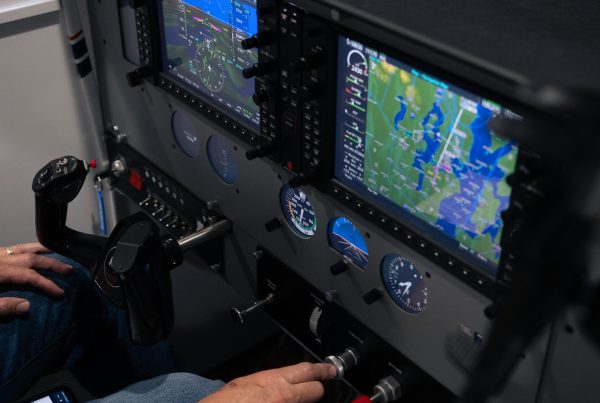
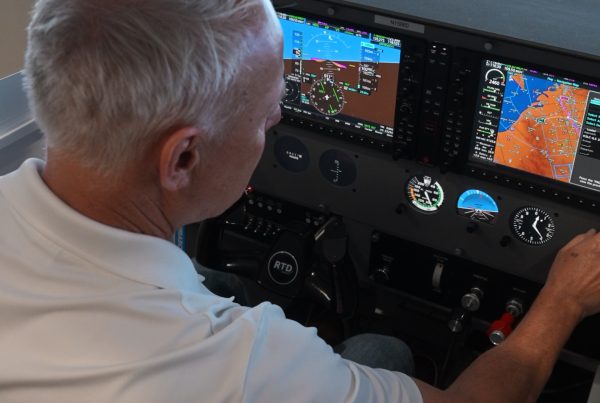
- Learn Advance Avionics – Our simulator is equipped with the Garmin G1000 NXi. This is the real Garmin software, not X-plane or Microsoft Flight Simulator.
Can I maintain IFR currency using the simulator?
Yes, If IFR-rated pilots can use an AATD to maintain their instrument currency by completing the following task, 6 Instrument approaches in the preceding 6 months, holding procedures, and intercepting and tracking courses.
What are the advantages of using a simulator?
Using a flight simulator offers numerous advantages for pilots at all levels. One significant benefit is the ability to build and reinforce proficiency without the risks and costs associated with actual flight. FAA-approved simulators provide realistic training environments that help pilots develop muscle memory and minimize the negative transfer of skills to real-world flying.
Additionally, simulators allow for the safe practice of emergency procedures and the handling of various system failures, which might be too dangerous or impractical to conduct in a real aircraft. They also enable pilots to experience and navigate a wide range of weather conditions, enhancing their preparedness for diverse flight scenarios. Overall, flight simulators are invaluable tools for improving safety, efficiency, and confidence in aviation.
Will it save me money?
- Using a flight simulator for flight training provides substantial cost savings for students. Simulators significantly reduce the expenses associated with fuel, maintenance, and wear and tear on actual aircraft, which can be considerable over time. Additionally, simulators allow for training sessions to be conducted regardless of weather conditions, leading to more consistent and efficient use of time. This efficiency means students can progress through their training programs faster and at a lower cost. Moreover, the ability to repeatedly practice specific maneuvers and scenarios without incurring extra costs makes simulators a highly economical choice. Overall, incorporating simulators into flight training programs offers a cost-effective way to achieve comprehensive, high-quality pilot education.
- The national average for the number of flight hours for a person to obtain their Private Pilot certificate is between 55-70. (The FAA minimum is 40 hours) If a student pilot uses a simulator as part of their training, the number of hours is closer to 50 as opposed to 70. At a rate of $175.00 an hour for plane rental alone, this could result in savings of $3,500 to the student for the cost of their Private Pilot certificate.